
The Peak Season Search Shift: What Buyers Will Do Differently in 2026
How changing search behaviour, AI, social discovery and advertising are reshaping the run-up to Black Friday, Christmas and beyond.
Think about how you might buy a new sofa or piece of home technology this autumn.
You could discover it on Instagram, save a few alternatives on Pinterest, watch reviews on YouTube, ask ChatGPT to compare specifications, check prices through Google Shopping, compare products via AI overviews in SERPs and read customer feedback before eventually purchasing on their phone.
Now consider someone buying Christmas presents. They might start by asking an AI assistant for gift ideas within a particular budget, discover an unfamiliar brand through TikTok, browse a retailer's gift guide, compare offers and return weeks later when the Black Friday promotions begin.
Or a family starting to think about next summer's holiday. They could research destinations through Google, explore hotels and experiences on Instagram and YouTube, use AI to narrow down suitable options and check reviews, before returning to travel websites to book during the January peak.
Three very different purchasing decisions, but something increasingly familiar connects them. Customers are researching in more places, using different types of information and often forming opinions well before they're ready to buy.
And this is before we consider B2B buyers evaluating suppliers, homeowners researching improvements or customers searching locally for an urgent service.
With the peak trading period approaching, October provides a useful opportunity to consider how much has changed since this time last year.
AI-assisted research is growing, product discovery is spreading across more environments, and advertising platforms are making more decisions about where budgets are spent and which messages customers see. Yet established search behaviour, brand familiarity, price, recommendations and trust remain hugely influential.
The commercial challenge is understanding which changes actually matter to your customers, and where they should influence your marketing plans.
So the real question is, how prepared are businesses for customers who may have already narrowed their options before their most important campaigns even begin?
Here are eleven search marketing developments and considerations worth paying attention to this October.
1. Peak-season buying decisions are beginning much earlier than the sale itself
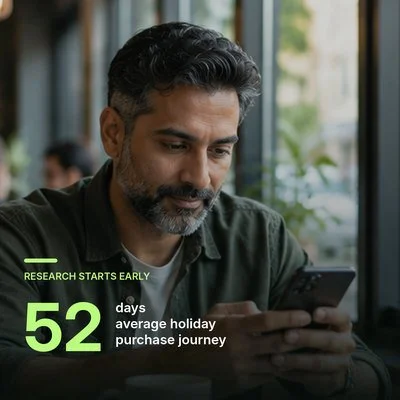
One of the most useful recent findings comes from Microsoft Advertising's latest holiday research. Its analysis suggests the average holiday conversion journey now lasts 52 days.
October accounts for the first recorded click in 56% of November conversions and 35% of December conversions within its research.
That is a particularly important consideration for businesses concentrating most of their Black Friday investment into the final few days of November. Many customers will already be familiar with the brands, products and prices they are considering.
Pinterest's October 2026 guidance reinforces this. Its research shows European Pinterest users are 43% more likely than non-users to begin festive shopping early and 28% more likely to research and plan further ahead.
TikTok's own UK figures from Black Friday 2025 tell a similar story. Tiktok sales during the week before Black Friday reached the same level as the platform's previous record sales day in 2024.
Customers are clearly not waiting for the traditional sales weekend to begin their buying journeys. There are important differences between audiences and categories, of course.
A customer replacing a broken washing machine might purchase within hours. Someone considering a new television could research specifications and prices for weeks. A buyer looking for a new sofa may spend considerably longer evaluating styles, materials, delivery options and retailers. This is where understanding customer behaviour becomes particularly valuable.
Businesses need to know when interest develops, how consideration changes over time and what prompts customers to move towards purchase.
Leadership takeaway:
Review historical search demand, customer journeys and conversion data to identify when research starts, not simply when sales occur.
Align budgets and messaging to those stages, building consideration early while retaining sufficient investment for high-intent demand during peak trading.
2. Gift buying is becoming a particularly interesting test of AI-assisted search
Gift buying involves a different kind of search behaviour. Often, the customer knows who they are buying for and roughly how much they want to spend, but has no particular product or brand in mind. That makes conversational search potentially useful.
Someone might ask for gift ideas for a teenager interested in gaming, a present for someone who enjoys cooking or something unusual for a colleague under £30.

Microsoft reports that inspiration-led searches, including gift guides and personalised gifting, have roughly tripled year on year in its holiday research.
Meanwhile, a new UK study published by Searchable on 21 October provides some revealing insight into what AI platforms currently recommend. Researchers repeatedly asked ChatGPT, Gemini, Google AI Overviews and AI Mode gift-related questions across ten categories. John Lewis was cited in around 30% of responses, followed by Boots at 18% and Menkind at 13%.
But perhaps the most interesting finding concerned the type of content being recommended. When users asked specifically about Black Friday deals, 82% of the retailer pages cited were deals pages. For broader gift-idea questions, gift and category pages accounted for 49% of citations.
Individual product pages represented a relatively small proportion.
There were also differences between gift categories. Independent comparison publisher Which? was the most-cited website for teenage gifts and technology, while YouTube featured in more than one in five responses from Google's two AI search experiences.
It is a focused study of particular questions, rather than evidence of universal AI ranking behaviour. Nevertheless, the implications are useful. A retailer with excellent products but limited gifting inspiration may be overlooking an important part of the customer's decision.
The opportunity extends to smaller brands too. Relevant products, distinctive positioning, credible reviews and strong supporting content can help unfamiliar businesses become part of the consideration set.
Leadership takeaway:
Review whether your content serves both customers looking for specific deals and those seeking inspiration without knowing what to buy.
Strengthen useful gift guides, category pages, product information and independent reviews, particularly around your most commercially valuable categories.
3. AI shopping is growing quickly, but customers are far from abandoning familiar habits
October has brought some particularly useful UK evidence about the role AI will play this Christmas.
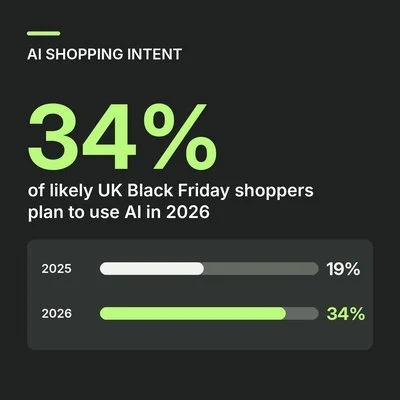
YouGov's Black Friday and Cyber Monday research found that 34% of likely shoppers intend to use AI during the sales period, compared with 19% last year. Among those considering AI, finding the best price was a leading motivation.
However, 48% of AI shoppers expressed concerns about biased or sponsored recommendations, and 47% of likely Black Friday shoppers said identifying genuine discounts was difficult.
There is growing interest in using AI to make better purchasing decisions, alongside considerable uncertainty about how much consumers should trust the recommendations.
Other research reinforces the need for perspective. An October study commissioned by Ozone and conducted by OnePoll found that only 8% of UK consumers considered AI tools a primary influence on what they would buy this Christmas. Among Gen Z, that rose to 17%.
The studies measure different things, but together they demonstrate how important it is to distinguish experimentation from established behaviour. AI is becoming another source of information for customers. Its influence will vary significantly by audience, product category and the complexity of the decision.
The technology is evolving rapidly too. On 15 October, Google announced more prominent links and source information within AI Overviews and AI Mode, including tests that highlight official websites when customers need authoritative information.
On the same day, Google launched Universal Cart in the US, allowing shoppers to organise products from multiple retailers, monitor price changes and access purchasing options across its ecosystem. Universal Cart is not yet a UK-wide shopping experience, but it illustrates how discovery, comparison and purchasing could become more closely connected.
For brands, the information available to AI platforms now has another role in shaping the customer journey.
Leadership takeaway:
Test how your products, services and brand are represented when customers ask realistic buying and comparison questions across major AI platforms.
Assess the commercial relevance of AI within your particular category before redirecting significant investment away from established, proven channels.
4. Social, video and visual search are becoming essential parts of product discovery

AI assistants are only one part of the wider change in search. Social platforms, short-form video, creator content, visual search and marketplaces now influence purchasing decisions in ways that are difficult to separate from traditional search marketing.
TikTok Shop's performance during Black Friday 2025 provides a particularly striking UK example. The company reported that:
Sales across the Black Friday and Cyber Monday period increased by 50% year on year.
Livestream shopping sales grew by 68%.
Searches for 'TikTok Shop Black Friday' increased by 404% over the Black Friday weekend.
The number of unique shoppers increased by 28%.
These are platform-reported figures, but they demonstrate the scale of activity taking place inside an environment many businesses still primarily categorise as social media.
Pinterest plays a different role. Customers often use it to explore styles, collect inspiration and save products for future consideration.
YouTube can help people understand products in more detail through demonstrations, comparisons, independent reviews and longer-form explanations.
And visual search is becoming increasingly practical for categories including furniture, homeware, interiors, fashion and travel.
Google's September Search Console update introduced separate reporting for multimodal searches, including Google Lens, image uploads and Circle to Search. We covered this in last month's update, but it is especially relevant when preparing for seasonal demand.
It is worth thinking about how those different environments work together. Someone might see a product in a creator's video, search for alternatives using an image, compare specifications on Google and eventually purchase directly from a retailer.
For home and lifestyle brands, strong imagery and demonstrations may influence the decision more than another piece of generic written content.
For technology products, detailed comparisons and independent reviews might carry greater weight.
For premium brands, the quality of the creative and the environments where products are discovered can be just as important as price.
Leadership takeaway:
Identify the platforms and content formats customers actually use when researching your categories, rather than assuming the same channel mix works for every audience.
Review the quality of product imagery, video, demonstrations, reviews and mobile experiences, prioritising those with a clear role in influencing purchase decisions.
5. Ecommerce readiness now extends well beyond promotions and paid traffic

For retailers, some of the most commercially valuable preparation ahead of peak season remains relatively straightforward.
Accurate product information, current pricing, reliable availability, effective landing pages, clear delivery promises and frictionless checkout experiences all influence whether demand becomes revenue.
However, the growing number of discovery environments raises the importance of getting those foundations right. Google's September commerce announcements placed particular emphasis on product feeds and the information required for AI-assisted shopping. That includes product attributes, availability, imagery, descriptions and other details used to understand and present relevant products. The quality of this information affects established Shopping advertising as well as newer discovery experiences.
It also has implications for how customers compare value. New research from Omnisend, covering consumers in the UK, US, Canada and Australia, suggests shoppers are planning to spend less during Black Friday and Cyber Monday this year.
Within its surveyed UK audience, average planned spending was £267, a reported 32% reduction compared with the previous year. Survey intentions are clearly not a forecast of actual sales, but the findings suggest value and affordability will remain prominent considerations.
That does not necessarily mean every retailer should compete on the deepest discount. Consumers may prioritise convenience, quality, delivery reliability, reassurance or a particular product feature, depending on what they are buying.
For some retailers, the biggest improvement might come from making a compelling offer easier to find and understand.
For others, it may be improving product availability, fixing a poor mobile checkout experience or focusing media investment on categories with stronger contribution margins.
Leadership takeaway:
Complete a joined-up peak readiness review covering product feeds, important landing pages, pricing, stock, promotional information, delivery, mobile conversion and tracking.
Establish which products, audiences and offers are commercially worth prioritising, accounting for discounts, acquisition costs, returns and fulfilment costs.
6. October's paid-search updates offer more control over increasingly automated campaigns
Google has continued developing its advertising products during October, with several updates particularly relevant to businesses preparing for seasonal peaks. On 14 October, Google announced new channel prioritisation and budget allocation controls across Search, Shopping, Performance Max and Demand Gen.
Advertisers can classify eligible channels by priority and place limits on the proportion of budget directed towards lower-priority inventory. The rollout will take place gradually across accounts and campaign types, and the controls are not guaranteed hard spending caps. Nevertheless, it is a welcome development for advertisers wanting greater influence over where their budgets are deployed.
Another October update introduced more detailed reporting into AI Max for Search. A new search terms and ad combinations report allows advertisers to inspect the queries, creative assets and landing pages selected by Google's increasingly automated systems.
Additional reporting columns also provide greater visibility into factors such as location-of-interest settings, brand inclusions and optimised targeting.
Together, these developments reflect an important shift. Advertising platforms are taking on more execution, from matching customer intent to selecting creative and determining where advertisements appear.
That can create efficiencies and uncover opportunities, particularly when demand changes quickly. But businesses still need to understand whether the resulting activity makes commercial sense.
A retailer might be generating impressive revenue through a campaign while concentrating spending on existing customers, low-margin products or categories with limited stock.
A service business might be generating more leads without any corresponding improvement in qualified enquiries.
Google's latest guidance, published on 21 October and featuring Ads Product Liaison Ginny Marvin, also highlights demand-led budgeting, bidding flexibility and the use of promotional tools during peak periods.
Leadership takeaway:
Review campaign budgets, bidding targets, channel allocation, promotional settings and reporting before demand and competition intensify.
Challenge the commercial quality of automated results, including customer acquisition, margin, lead quality and whether additional spend is producing worthwhile growth.
7. Better audience insight and marketing data could be the biggest competitive advantage
The expansion of search platforms creates more opportunities to reach customers, but also more opportunities to waste money. With so much attention on AI, algorithms and advertising features, it is easy to overlook the importance of understanding the customer.
A business might have sophisticated advertising technology, automated bidding and detailed reporting, yet still lack a clear view of which customers are most valuable, why people buy or what influences their decisions.This matters particularly during competitive seasonal periods.
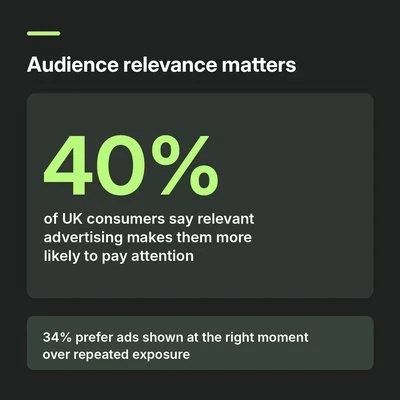
October research from Ozone found that 40% of UK consumers were more likely to pay attention to advertising or feel positively towards a brand when the advertising was relevant to what they were doing or thinking about.
A further 34% favoured advertising delivered at the right moment over seeing the same message repeatedly.
That should prompt businesses to examine the quality of their audience understanding. Not every customer is motivated by the same offer.
For an ecommerce brand, useful distinctions might include first-time and returning customers, gift buyers, price-sensitive shoppers, premium customers and people purchasing within specific categories.
For a travel business, different audiences may prioritise family facilities, flexibility, destination experiences, price or luxury.
For B2B, the same service might be evaluated differently by a Managing Director, Marketing Director and Finance Director.
The opportunity is to use existing customer and marketing data to inform better decisions. That might include combining:
Customer and CRM data: Purchase history, customer value, retention, enquiry quality and repeat behaviour.
Website and search data: Search terms, landing pages, internal site searches, journeys, device usage and conversion patterns.
Commercial data: Product margins, returns, stock availability, average order values and sales profitability.
Qualitative insight: Customer feedback, reviews, sales conversations, service enquiries and the reasons people choose or reject a business.
Market and audience research: Seasonal trends, competitors, category behaviour and the motivations behind purchasing decisions.
This also helps businesses give their advertising platforms better information.
On 13 October, Google announced further first-party data and measurement updates, including expanded Data Manager integrations, enhanced conversion capabilities and a new Data Strength Uplift metric. Google reported that advertisers using its Tag Gateway data infrastructure saw an average conversion uplift exceeding 20% in Demand Gen campaigns in its internal analysis. That is a platform-reported result, not a guaranteed improvement for every advertiser. It does reinforce the potential value of improving data quality.
The more automated marketing becomes, the more important the information guiding that automation becomes.
Leadership takeaway:
Bring customer, marketing and commercial data together to identify valuable audiences, meaningful buying signals and opportunities to improve conversion or retention.
Audit the quality of conversion tracking, CRM integrations, audience segments and campaign objectives, ensuring platforms optimise towards outcomes the business actually values.
8. Organic search has another Google update to account for, while content quality remains critical
Google completed its September 2026 spam update on 8 October, following a rollout lasting almost two weeks. Search Engine Journal reported that it was the longest of Google's four spam updates this year.
For businesses relying on organic visibility ahead of important trading periods, the completed rollout provides a useful window for reviewing performance. However, movements in rankings or traffic should be evaluated carefully.
Seasonality, competition, customer demand, SERP changes and technical issues can all contribute to fluctuations. A decline in clicks without a similar decline in search visibility may tell a different story from a genuine loss of rankings.
There was another quieter Google change on 1 October. Google updated its guidance on generative AI content, incorporating information from its Search Quality Rater Guidelines. The emphasis remains on useful, accurate and original content that adds value for readers. Generating large volumes of pages without meaningful value risks falling foul of Google's scaled-content abuse policies. This is particularly relevant for businesses creating seasonal content at speed.
Generic Black Friday landing pages, automatically generated gift guides and repetitive category content are unlikely to provide lasting competitive advantage if they add little that customers cannot find elsewhere. Original product knowledge, useful comparisons, practical expertise and genuine customer insight offer stronger foundations.
Google also expanded the prominence of links to original sources within its AI search experiences during October, continuing its efforts to connect answers with relevant websites.
For retailers and service businesses, this strengthens the case for keeping valuable content accessible, accurate and technically sound.
Leadership takeaway:
Review important organic landing pages and search performance around the 24 September–8 October update period before making changes based on apparent ranking movements.
Prioritise accurate, distinctive and genuinely useful content, supported by sound technical SEO, structured product information and strong internal linking.
9. Home and property provides a clear example of search becoming more conversational

One more interesting UK developments this month came from Rightmove. On 13 October, the property platform announced its new AI-powered Comparison Assistant, built using Google Gemini.
The feature allows customers to compare properties directly within search results, asking questions that go beyond traditional filters such as price, location and number of bedrooms. Someone might ask which property is most suitable for home working, compare outdoor space or investigate access to schools, transport and local amenities. The information is drawn from property listings and supporting data sources to help people evaluate suitability more easily.
Rightmove reports that users of its existing AI search assistant spend 40% longer on the platform, save more than twice as many properties and generate around twice as many agent leads compared with non-users.
Instead of simply matching a list of requirements, platforms can help customers interpret which options might best suit their circumstances. For estate agents and property developers, detailed listings, accurate information, compelling photography and clearly explained benefits may become even more important.
The implications extend beyond property portals. Consider someone researching a new kitchen, bathroom, heating system or home improvement project.
Their journey might involve visual inspiration, local search, AI-assisted comparison, manufacturer information, reviews and examples of previous work before they contact a supplier.
Others may have an immediate need, such as urgent heating repairs during winter, where proximity, availability and reassurance become much more important.
Understanding those differences helps shape everything from search strategy to website content and enquiry handling.
Leadership takeaway:
Evaluate how well your website, listings and supporting content answer the practical questions customers ask when comparing providers or properties.
Separate urgent local demand from longer-term consideration journeys, with appropriate content, advertising, trust signals and conversion experiences for each.
10. Travel and leisure businesses should already be thinking about January demand
For travel and leisure, October and November have a different commercial significance. While some customers are looking for winter breaks, experiences or Christmas gifts, others are already considering their 2027 holidays.

The January booking period remains a major opportunity, but the research and inspiration influencing those bookings often begin considerably earlier. ABTA's October Holiday Habits 2026–27 research provides an interesting picture of how customers now find holiday inspiration. The proportion using AI has grown from 4% in 2024 to 8% in 2025 and 14% in 2026. Among 25–34-year-olds, the figure reaches 29%.
Yet traditional influences remain considerably more popular. Recommendations from friends and family lead at 42%, followed by conventional internet searching at 37% and travel websites and guidebooks at 35%.
Customers may be experimenting with AI to develop itineraries, compare destinations or shortlist hotels, while still relying on reviews, established operators and trusted recommendations when deciding where to book.
Visual discovery also plays a significant role. Destinations, hotels and experiences are particularly suited to video, imagery, social content and creator recommendations.
For a family researching a holiday, practical information about facilities, transfers, accessibility, activities and total cost can be as important as inspirational destination imagery.
Travel businesses also need to consider how easily customers can move from inspiration to checking availability and completing a booking. A compelling destination guide loses commercial value if the booking journey is confusing or the customer cannot find the information they need.
Leadership takeaway:
Review the relationship between autumn research behaviour and January booking demand, identifying the destinations, experiences and audiences worth influencing early.
Strengthen inspirational and practical content, reviews, availability information and booking journeys across the platforms customers use to research their next trip.
11. For B2B, the final quarter is often when next year's buying decisions begin
It would be easy to treat the coming weeks as a predominantly retail-focused search opportunity. However, the same changes in discovery, comparison and evaluation are influencing how organisations purchase services, technology and specialist expertise.
For many businesses, the final quarter is when leadership teams review budgets, assess existing suppliers and begin making plans for the following year. A search in October may contribute to a supplier shortlist or investment decision that does not convert into revenue until 2027.
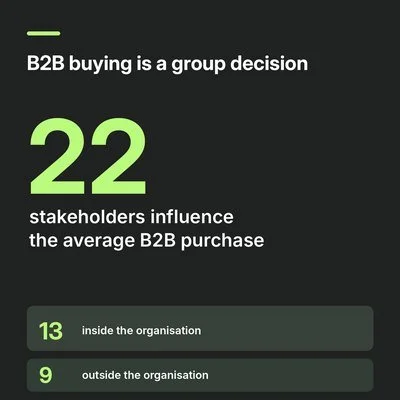
Recent research from LinkedIn's B2B Institute highlights just how complicated these decisions can be. Its Buyability research reports an average of 22 stakeholders influencing B2B purchases, including people inside and outside the buying organisation.
It also reports that 92% of buyers begin with at least one vendor already in mind, while much of the research journey takes place before direct sales engagement. The findings underline the importance of being known and credible before an organisation starts formally evaluating providers.
For B2B marketers, search visibility needs to support different motivations across the buying group. A commercial leader may want evidence of growth or efficiency. A technical stakeholder might focus on functionality and integration. Finance may need reassurance around costs, risk and return on investment.
Strong service pages and commercial-intent search remain important, but so do useful expertise, case studies, clear propositions, third-party credibility and the ability to demonstrate relevant experience.
This is also where the connection between marketing and CRM data becomes particularly valuable. A campaign generating enquiries is useful. Understanding which enquiries become qualified opportunities, progress through the pipeline and generate revenue is considerably more useful.
Leadership takeaway:
Identify the questions, concerns and evidence requirements of different stakeholders involved in your customers' buying decisions.
Align search, content, sales and CRM reporting to understand which activities are contributing to qualified pipeline and future revenue, particularly ahead of 2027 planning.
Leadership Perspective: Better customer understanding creates better search decisions
The developments we've explored this month are varied, but the implications are connected. Search is spreading across more platforms, formats and experiences.
Customers can discover products through video, compare alternatives with AI, investigate reputation through independent sources and complete purchases without following the traditional search-to-website journey.
For ecommerce brands, this creates opportunities to influence customers earlier and convert demand across more environments.
For home and property, it changes how customers compare suitability and evaluate providers.
For travel, inspiration and planning are becoming more connected to conversational and visual discovery.
For B2B, the importance of recognition, credibility and evidence continues to grow.
The challenge for leadership teams is deciding what deserves attention.
There is no shortage of technology, channels, campaign features or tactical recommendations. The risk is that businesses respond by adding more activity without understanding whether it improves results. This is where strategy, audience understanding and sound commercial judgement become especially important.
Before deciding where to spend more, businesses should understand the customers they most want to attract, the decisions those customers make and the factors influencing their choices.
That understanding should guide marketing priorities, channel investment, content, proposition, data and measurement. The same principle applies to the growing use of automation.
Platforms can become increasingly sophisticated at finding audiences and optimising campaigns, but they still depend on the objectives, data and information supplied to them. Businesses with clearer audience understanding, stronger commercial data and better strategic direction should be in a stronger position to benefit.
With peak season approaching and 2027 planning already underway, this is a useful time to challenge whether marketing investment reflects how customers genuinely behave today.
Leader's Checklist: Preparing for the Peak Season
Five practical questions worth reviewing with your marketing team, agencies or leadership colleagues:
Do we understand when and where our customers make their decisions? Use audience research, search trends, customer data and buying-journey insights to identify opportunities to influence demand earlier.
Are we visible and credible across the environments that matter? Review search engines, AI platforms, video, social discovery, marketplaces, reviews and other relevant sources, prioritising those your audiences actually use.
Are our campaigns, content and websites ready? Check seasonal landing pages, product feeds, advertising budgets, conversion tracking, availability, mobile experiences and customer reassurance.
Are we using marketing and commercial data effectively? Understand which customers, products and services generate the greatest value, and ensure campaign objectives reflect revenue quality, profitability and longer-term customer value.
Are we making decisions for the remainder of 2026 and the opportunities developing in 2027? Balance immediate demand generation with activity that builds consideration, trust, qualified pipeline and future growth.
Final Thought
Peak trading periods have always rewarded businesses that understand their customers, prepare early and execute effectively.
What has changed is the number of places where people discover and compare their options, and the growing role technology plays in helping them reach a decision. Google search still matters enormously. So do effective advertising, useful websites, competitive offers and good customer experiences. Social, video, AI assistants and other discovery platforms are adding further opportunities to influence the journey.
But businesses shouldn't confuse the number of opportunities with the need to pursue them all. The greatest value will come from understanding which customers matter, what shapes their decisions and where marketing can make a meaningful commercial difference.
For some businesses, the next few weeks will determine a significant proportion of annual revenue. For others, this is when next year's opportunities begin taking shape. Either way, I think the same question is worth asking:
How much of your customers' next buying decisions will be made before they ever reach the point of purchase, and are you doing enough to influence them?
Get these updates directly in your inbox
From November, we'll be sharing our monthly Search Marketing Takeaways for Leaders and AI in Marketing Takeaways for Leaders directly to your inbox. Each month, we'll bring together the most relevant developments, useful research and practical considerations for marketing and business leaders, helping you stay informed and make more confident decisions.
Next month, we'll be looking at planning an effective digital and marketing strategy for 2027, including where to focus, what to prioritise and how to build a plan that delivers meaningful commercial results.
Sign up to the Saurce newsletter in the footer to get these updates directly in your inbox.
Useful Links & Further Reading
Microsoft Advertising — Winning the 2026 Holiday Shopper: Six Global Trends - Read the Microsoft Advertising research
YouGov — The Bots and the Basket: AI's Role in UK Black Friday and Cyber Monday 2026 - Read the YouGov research
Searchable — Which Retailers and Products Does AI Recommend for Black Friday Gifts? - Read the October UK analysis
Ozone — AI, Trust and UK Christmas Shopping Behaviour - Read the consumer research
Pinterest — From Saves to Sales: Black Friday and Cyber Monday Strategy - Read Pinterest's October guidance
TikTok — UK Black Friday 2025 Shopping and Livestream Performance - Read the TikTok Shop results
Google — More Ways to Connect With the Web Through AI Search - Read Google's October search update
Google — Universal Cart and the Future of AI-Assisted Shopping -Read the October shopping announcement
Google — Agentic Commerce Updates and Product Feed Best Practices - Read Google's retailer guidance
Omnisend — Black Friday and Cyber Monday 2026 Spending Predictions - Read the international consumer survey
Search Engine Land — Google Ads Introduces Channel Prioritisation and Budget Allocation Controls - Read the October Google Ads update
Search Engine Land — New AI Max Search Terms and Ad Combinations Reporting - Read the AI Max reporting update
Google Ads — New Bidding and Budgeting Tools for Holiday Campaigns - Read Google's October guidance
Google Ads — Build Your Data Strength With October's Demand Gen Updates - Read Google's first-party data and measurement update
Search Engine Journal — Google September 2026 Spam Update Completed - Read the Search Engine Journal coverage
Google Search Central — Guidance on Generative AI Content and Search Quality - Read Google's updated guidance
Rightmove — AI-Powered Property Comparison Assistant - Read Rightmove's October announcement
ABTA — Holiday Habits 2026–27: AI and Changing Travel Inspiration - Read the ABTA research
LinkedIn B2B Institute — Buyability and the Modern B2B Buying Journey - Explore LinkedIn's B2B research
