
The funnel isn’t broken. It’s just not how people buy anymore.
Most marketing teams still plan as if attention moves in a tidy line: awareness, consideration, purchase, loyalty. It is a useful simplification, but it is increasingly out of step with reality.
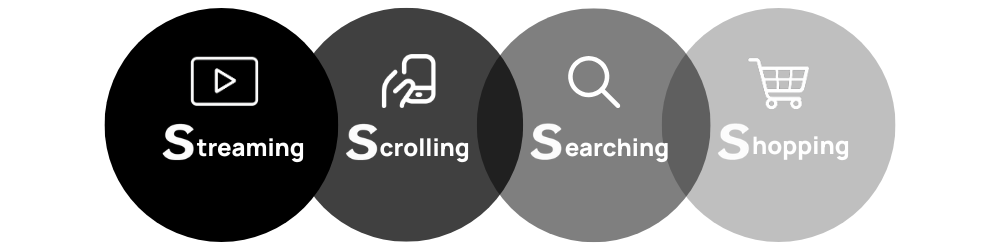
A recent Think with Google article, based on Boston Consulting Group research, suggests that modern consumer decision-making is shaped less by “stages” and more by four overlapping behaviours: streaming, scrolling, searching and shopping (the “4S”).
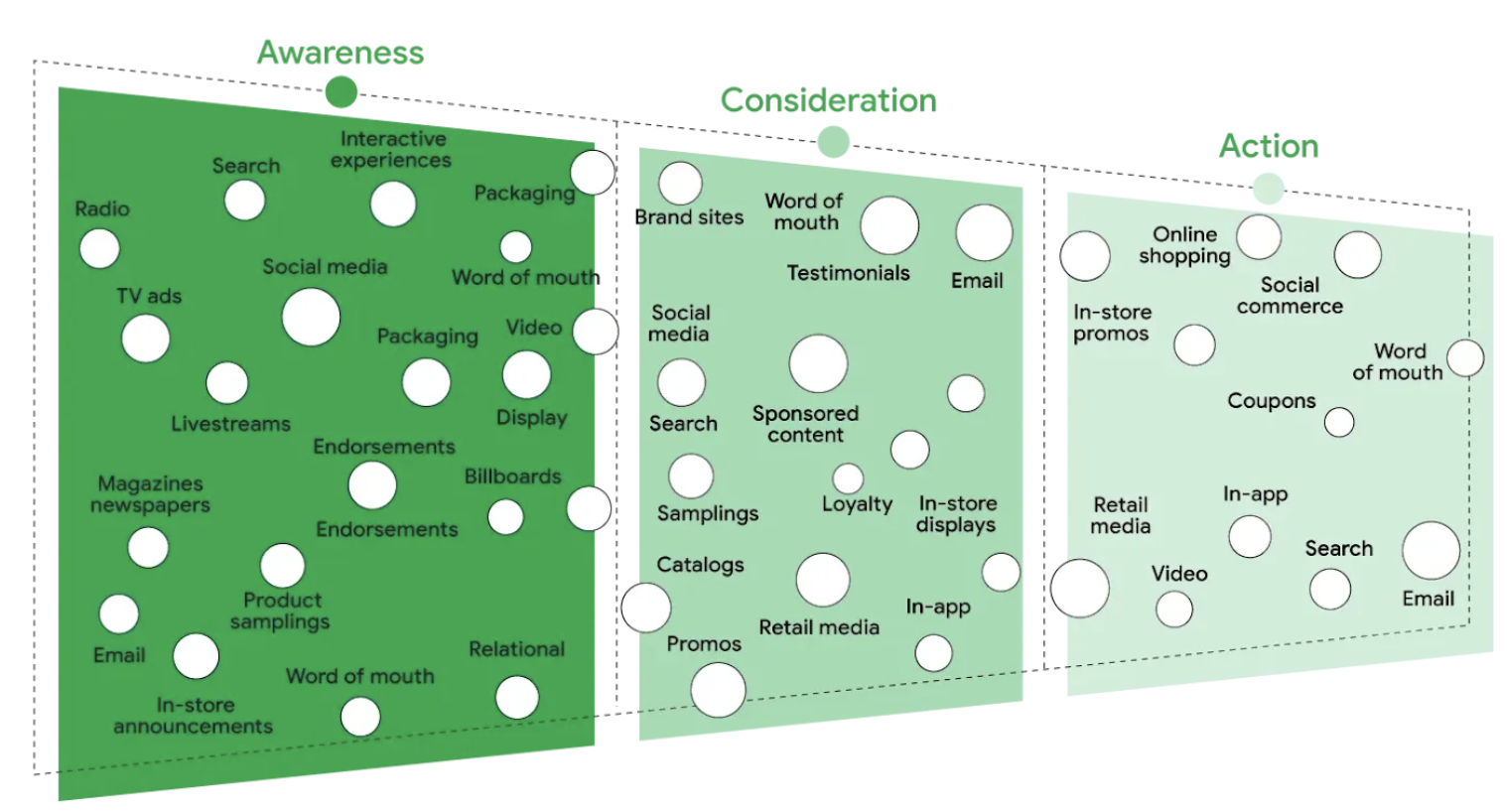
Source: Based on BCG analysis via Google Trends
The value here is not a new acronym (as if we don’t have enough already!). It is a better way to diagnose why performance can feel unpredictable even when you are doing the right things in each channel. People are discovering, validating and deciding across multiple surfaces, often at the same time, and often on mobile.
If you lead marketing, this creates a simple challenge:
How do you build a digital ecosystem that performs when the journey is fragmented, concurrent, and influenced by more than your paid plan?
What follows is a practical way to use the 4S as a thinking tool, plus actions you can take without turning this into a channel checklist.
The 4S behaviours, in plain English
1) Streaming
People watch to learn, to be entertained, and to reduce risk. Video is no longer “upper funnel”. It influences preference and confidence throughout the journey.
Streaming is where trust is built and where brand meaning is demonstrated, not just stated.
Questions to ask:
If someone watched three minutes of our best content, what would they understand that makes choosing us easier?
Are we answering real questions, or just broadcasting messages?
2) Scrolling
Discovery through feeds is not passive. It is pattern recognition. People are looking for cues: relevance, credibility, desirability, social proof.
Questions to ask
What signals do we consistently show, or fail to show, when people encounter us in a feed?
Does our creative and content reflect how people actually talk about the problem?
3) Searching
Search still matters, but as alluded to in a previous post it is broader than “Google keywords”. It includes queries on marketplaces, forums, social platforms, and increasingly AI-led experiences. The important point is intent: searching is where people try to reduce uncertainty.
Think with Google’s point is that searching happens alongside the other behaviours, not in a neat sequence. This is where clarity wins. Not just ranking, but being the best answer.
Questions to ask
Where do we genuinely help, versus where we just appear?
Are we building content that adds distinct value, or repeating what everyone else says?
4) Shopping
“Shopping” is not just ecommerce. It is any moment where people compare options, check availability, validate price, assess risk, and decide. This can happen on your site, on a reseller, on an aggregator, or in a conversation with a friend.
Shopping is where friction is punished. People will not work hard to buy from you.
Questions to ask
Where do we lose people when they are ready to act?
Are we making it easy to choose us, or simply possible?
What marketing leaders should do differently, without creating more work
The biggest risk with frameworks like this is that teams treat them as four new channel strategies. That usually creates activity, not progress.
Instead, use the 4S as a way to align leadership around three decisions.
Decision 1: What are we trying to influence?
Funnels often focus on attribution. Influence maps focus on what actually changes demand and confidence.
Action: Define the two to three behaviours that most reliably move people closer to choosing you, for your category. Be explicit.
Examples by sector:
Later living, property, high consideration services: reassurance, proof, credibility cues.
Retail and ecommerce: availability, value framing, speed, trust.
Travel and leisure: inspiration, validation, risk reduction, and “what is it really like?”
Decision 2: What signals are we sending at each behaviour?
People do not evaluate you in one place. They accumulate signals across streaming, scrolling, searching and shopping.
Action: Create a simple “signal audit”.
Trust signals: reviews, credentials, proof, expertise, third-party validation.
Clarity signals: what you do, who it is for, why it matters, what it costs, what happens next.
Reassurance signals: guarantees, support, transparency, examples, constraints explained.
Then check: are these signals present consistently across the places people actually encounter you?
Decision 3: Are we structurally set up to win in a fragmented journey?
Most underperformance is not a channel issue. It is a system issue: ownership, prioritisation, measurement, and the gap between brand and performance.
Action: Pressure-test four practical areas.
Content and creative alignment: Do paid, organic, and onsite content reinforce the same story and proof?
Technical readiness and friction: Are there avoidable drop-offs in speed, user experience, tracking, or journeys?
Measurement that leaders can use: Do you have a view of what is working that is not purely last click?
Operating rhythm: Are decisions made quickly with a shared fact base, or are teams debating opinions?
A simple way to bring the 4S to life
If you want a pragmatic starting point, you could follow these steps:
Pick one priority audience and one commercial goal.
Map how that audience typically moves across the 4S’, based on real behaviour, not channel ownership.
Identify the one moment where confidence is won or lost.
Improve the signals and reduce friction at that moment.
Measure progress using a small set of leading indicators, not just final conversions.
The aim is not to do more in every S. It is to focus effort where it changes outcomes.
How we can help
At Saurce, we typically see teams already investing across channels. The opportunity is to make that investment work harder by building a connected digital ecosystem: clearer signals, less friction, and a sharper view of what is influencing decisions.
If you want a practical way to apply the 4S to your business, we can help you translate it into priorities, an action plan, and a measurable operating rhythm, without turning it into a reinvention project. The aforementioned audits are a great starting point.
Source and credit
Think with Google, “Consumer journeys have changed. Find out how the 4S behaviors can redefine your marketing”, Think with Google Editorial Team, based on Boston Consulting Group research.
